

BLOG
Factory Audit Guide: What to Check When Visiting a Bedding Manufacturer
A bedding factory audit is decided by three things you can only see on site: how material is received and stored, how the line is set and recorded, and whether the paperwork you were sent matches the floor you are standing on. Ask for the process route and the test reports before you travel, then spend the visit trying to break the story those documents tell.
This guide is written for buyers who already have a shortlist and are about to spend a day in a sewing hall. It is not about choosing a supplier; it is about verifying one, and about writing findings that someone else can check after you have gone home.
What Should You Ask For Before You Book the Visit?
Request the process route, the scope certificates, and a test report for the exact product you intend to buy — before the date is fixed. Most weak audits fail here rather than on the floor: the buyer arrives without knowing which processes are in-house, and spends the day being shown a sample room instead of the line that will run their order.
Three documents change what you look at when you arrive:
Process route with in-house and subcontracted steps marked. If quilting, dyeing or embroidery is bought in, the audit has two sites, not one.
Certificate scope, not just the certificate. A quality management certificate names the site and the product range it covers. Check the address on the document against the address of the gate you walk through, and check that the range covers what you are ordering.
A test report for the same construction you are buying. A report for a similar item is not evidence for your item; where a figure is not on the report, it stays unconfirmed until the batch result is issued.
Two external frameworks are worth reading before you go, because they define the vocabulary the factory will use back at you. The social-compliance standard behind most Asian factory audits is amfori BSCI, and the chemical-safety scheme most bedding buyers ask for is OEKO-TEX Standard 100, which tests the finished article rather than the raw fibre.
What Does the Cutting and Sewing Floor Tell You?
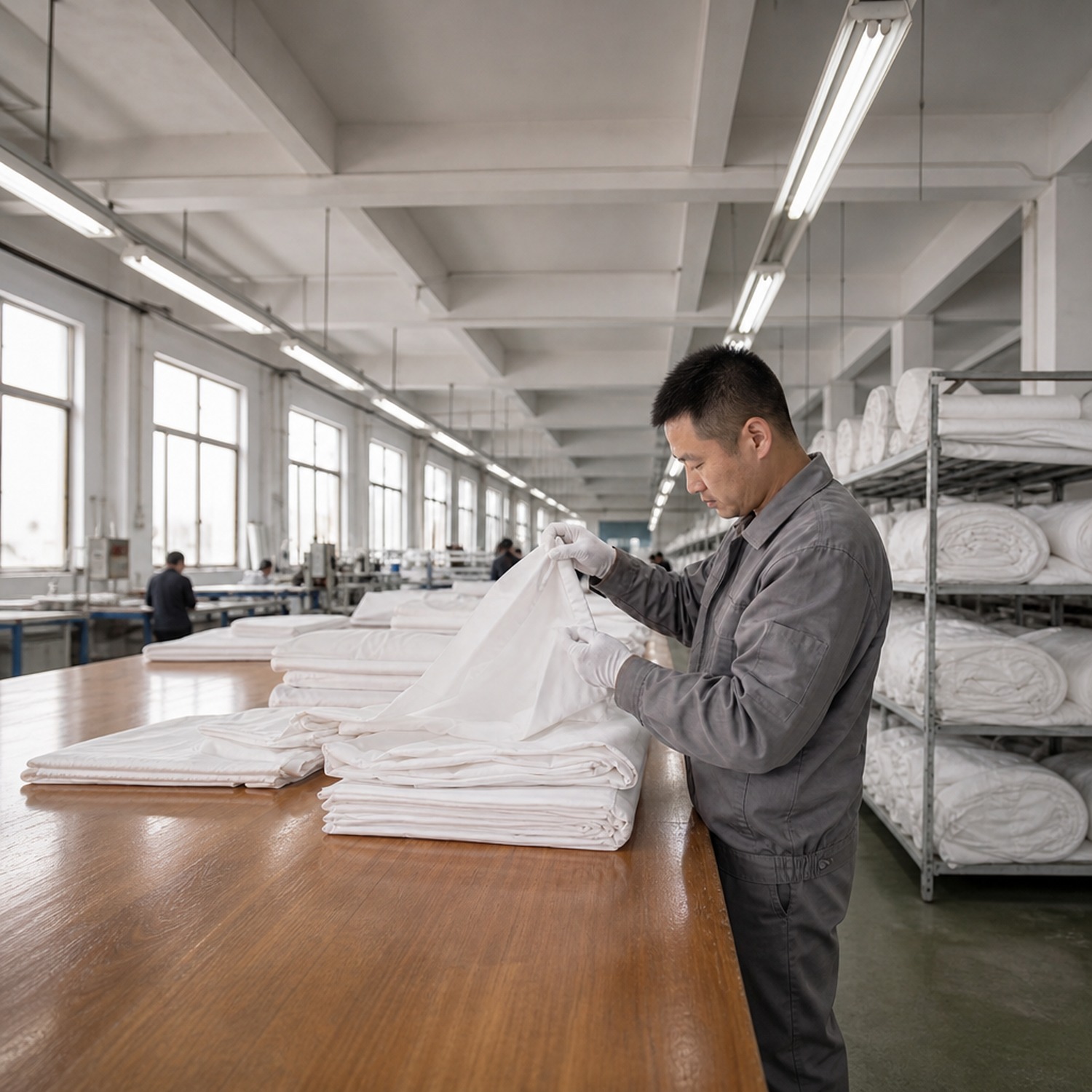
The sample room is a display; the cutting table and the sewing line are the evidence. Walk the floor in process order — fabric store, cutting, bundling, sewing, finishing — and ask the same question at each station: what is this bundle, what order is it for, and where does it go next.
At cutting, watch how the marker is laid and how cut parts are bundled. A bundle ticket that carries order number, size, lot and quantity is the difference between a traceable order and a pile of parts. Check whether shade bands are kept together: if two rolls of slightly different tone are cut into the same bundle, the defect appears after washing, not before.
At sewing, look at the machine settings rather than the finished sample. Ask the line supervisor to check stitch density on the machine that will run your order, and compare it with the figure on your specification. Then ask where broken needles go. A factory with a needle log and a metal-detection step downstream is managing a real risk; a factory that answers "we are careful" is not.
Three things are worth timing rather than asking about:
1. How long a bundle sits between processes. Long waits mean work-in-progress is being used as a buffer, and buffer stock is where size and shade get mixed. 2. How often the line stops for a machine fault. A maintenance board with dates is a record; a verbal "we service regularly" is not. 3. Whether the operator can explain the tolerance. Ask a sewer what happens when a panel comes in a few millimetres short. The answer tells you whether quality is a system or a person.
How Do You Audit Fill, Fabric and Material Handling?
Material handling is where a factory's real discipline shows, because nobody photographs it. Incoming fabric should be inspected against a written standard — the four-point system is the usual one — with the result recorded per roll, not per shipment. Roll labels should carry lot, width, weight per square metre and inspection result, and the store should be able to pull the lot used on any finished piece.
Fill needs its own questions. Down and feather are hygroscopic: they take up moisture from the air and lose loft when stored damp, so ask to see where fill is kept, how it is sealed, and whether there is a quarantine area for material that has failed inspection. If your product contains down or feather, the test house that most buyers reference for composition and fill power is IDFL; knowing which tests the report covers is more useful than the report's headline number.
The table below is the audit sheet we suggest for this part of the visit. Each row is something you can see in ten minutes, and each has a failure signal that does not depend on the auditor's opinion.
| What to audit | What you look at | Failure signal |
|---|---|---|
| Incoming fabric inspection | Per-roll record with defect map and four-point score | One inspection sheet per shipment, no roll numbers |
| Shade control | Rolls banded by tone and kept together through cutting | Mixed tones inside one bundle, no band labels |
| Lot traceability | Lot number on the bundle ticket and on the finished carton | Cannot name the roll used for a specific order |
| Fill storage | Sealed, dry, off-floor storage with a quarantine area | Open bags, damp smell, no reject area |
| Moisture control | Humidity reading in the fill store, taken on the day | No instrument, or a reading nobody records |
| Needle and metal control | Needle log plus metal detection before packing | No log, or detector bypassed when it alarms |
| Work in progress | Bundles labelled and moved in process order | Unlabelled piles, several orders mixed on one table |
What Turns an Observation Into a Non-Conformity?
An audit finding is not an adjective. "The cutting room was untidy" cannot be closed, verified, or argued with; "three of twelve bundles carried no order number" can be. Write every finding with the location, the evidence and the criterion you are measuring against, and classify it so the factory knows what stops the shipment.
A workable three-level scheme:
Critical — a defect that creates a safety or compliance exposure, or that cannot be corrected after packing. Stop and agree a containment before you leave the site.
Major — a system failure that will produce defects at volume, such as missing traceability or an uncalibrated detector.
Minor — a single lapse with no systemic cause, corrected on the spot.
Then attach a corrective action to each: what will change, who owns it, by when, and how you will see that it closed. Closure by photograph is acceptable for minor items; major items should be re-checked on the next visit or by a third-party follow-up. If the factory cannot name an owner for a finding, the finding will not close.
One practical note on evidence: photograph the finding next to its bundle ticket, so the image carries the order number. A photograph of a defect alone is unusable three months later when the factory disputes which order it came from.
Frequently Asked Questions About Bedding Factory Audits
How long should a bedding factory audit take?
One full working day for a single-product audit, plus a closing meeting. Anything shorter turns into a tour; anything longer usually means the factory is assembling evidence while you wait.
Should I audit before or after the sample is approved?
After the sample is approved and before bulk starts. Auditing before approval means you are checking a process for a product that does not exist yet; auditing after bulk has begun means defects are already in the warehouse.
Can a factory audit be done remotely?
Partly. Documents, certificates and a video walk can screen a supplier, but they cannot confirm whether the bundles on the floor carry order numbers. Use remote checks to decide who to visit, not to replace the visit.
What is the difference between a factory audit and a product inspection?
An audit examines the system that produces the goods; an inspection examines the goods themselves, usually at the end of the line or before shipment. A factory can pass an inspection and still fail an audit on traceability.
Do I need my own auditor?
Not necessarily, but the auditor must be able to read the specification. A generalist inspector will confirm that stitching exists; it takes someone who knows the product to notice that the seam type is wrong for the wash cycle.
What if the factory will not open part of the building?
Treat a refused area as a finding rather than an inconvenience. Ask what is in it, and write the refusal into the report with the reason given. Buyers who accept a closed door usually discover the reason in the first bulk shipment.
If you are planning a sourcing trip that includes several factories, it helps to compare notes on how each one presents its process route; the differences are often more informative than the similarities.
If your shortlist includes a Chinese bedding factory, the most efficient version of this audit is a single day that covers fabric inspection, cutting, sewing, fill handling, finishing and the warehouse, with the quality manager in the closing meeting rather than at the door.
Comfytouch is the bedding brand of Anhui Comfytouch Ltd, an OEM and ODM manufacturer in Hefei, Anhui, running home bedding and hotel bedding on one site, for buyers in Europe, North America and South America. We are happy to open the process route, the material store and the line that would run your order, and to have the relevant test reports on the table when you arrive. Our certifications are: OEKO-TEX Standard 100 No. 21.HCN.83824 | ISO 9001:2015 No. ECI22Q00239R1S | ISO 14001:2015 No. ECI22E00129R1S | BSCI copy on request.
To arrange a factory visit or to ask for the audit pack in advance, use the contact form, or review the documents we keep on our certificates page. If you are comparing factories before travelling, the trade fair calendar is also a reasonable first filter; Heimtextil is where most European bedding buyers meet suppliers in one week.
Related Photo

Silk Bedding Sets: What to Ver
What to verify before ordering silk bedding sets: configuration, shade

Silk Pillowcases for Hotels: M
How hotels specify silk pillowcases: weave, momme, closure and seam co

Goose Down and Duck Down Duvet
How to compare down duvets on fill power, fill weight and construction
Goose Down vs Duck Down Pillow
Goose down vs duck down pillows compared on loft, fill weight, constru

Duck Down and Feather Mattress
What hotels should specify in a down and feather mattress topper: fill
How to specify duck feather cushion cores for upholstery and hotel pro
Categories
Latest News
- Comfytouch at the 140th Canton Fai2026-10-09
- Comfytouch Bedding Heads to EQUIPO2026-09-02
- Heimtextil 20262026-01-14
- Join us in Frankfurt {13 to 16 Jan2025-11-11
- The 138 th canton fair in guanzhou2025-11-11


 Email
 WhatsApp
 WeChat
 Phone