

BLOG
What Is Momme Weight in Silk Bedding? A Buyer's Guide
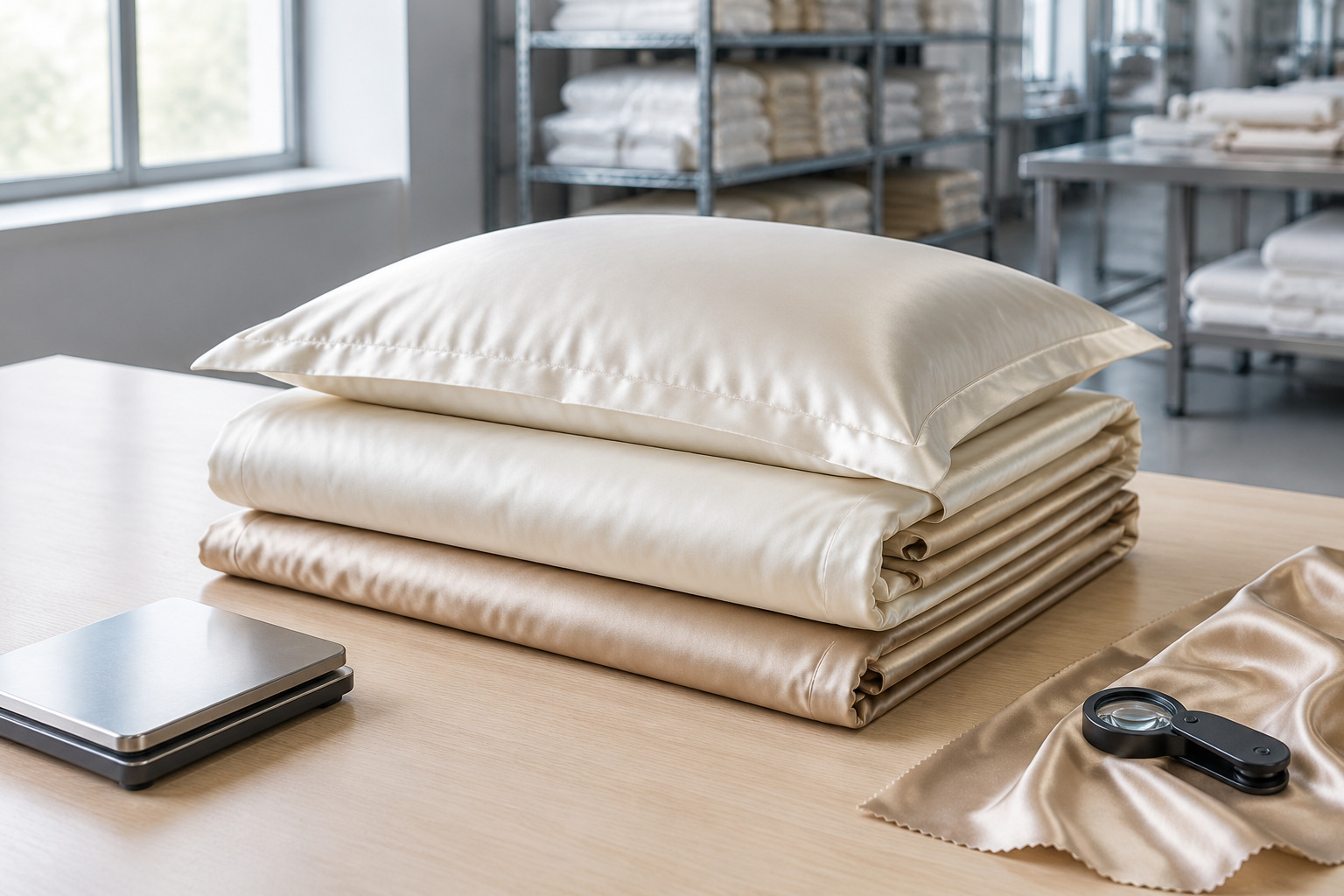
Momme weight is the standard density measure for silk fabric: it states how many pounds a 100-yard length of 45-inch-wide silk weighs, so a higher number means a heavier, denser cloth. For bedding, 19 momme is the practical entry point for pillowcases, 22 momme is the mainstream retail and hospitality specification, and 25 momme and above is chosen when a buyer wants a weightier hand feel and a longer wash life.
If you are sourcing silk bedding for a retail range or a hotel programme, momme is the first number on the specification sheet and the one most often quoted loosely. This guide explains what the unit actually measures, how it converts to the grams-per-square-metre figures your mill and your lab will use, which weights suit which products, and how to verify the number before you commit to a purchase order.
What Does Momme Weight Actually Measure?
Momme is a Japanese unit that survived as the international convention for silk because it describes a finished fabric rather than a yarn. One momme is the weight in pounds of a piece of silk 45 inches wide and 100 yards long; the fixed dimensions matter, because the same cloth cut wider or shorter would give a different number.
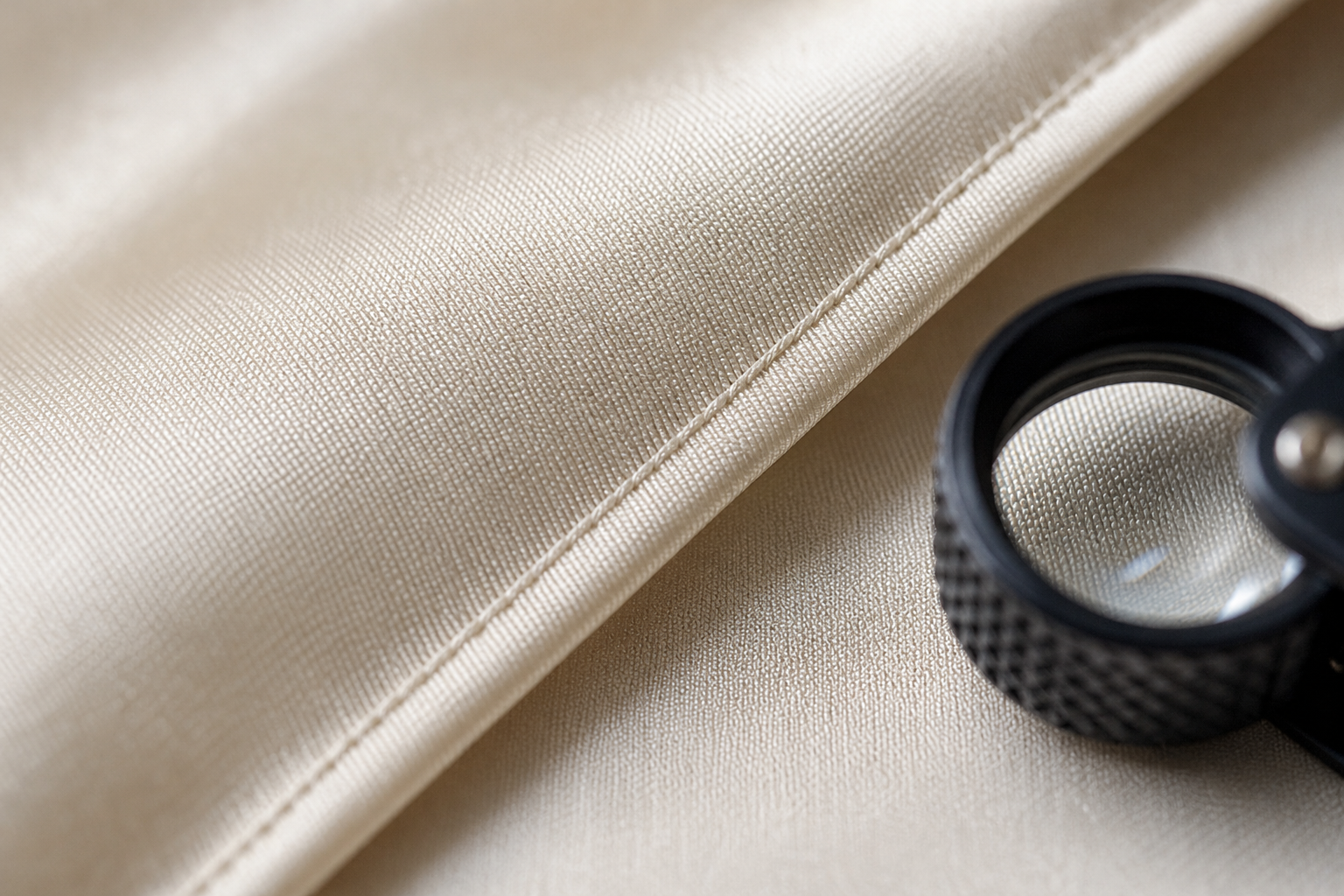
Two consequences follow. First, momme describes density, not quality: it tells you how much silk fibre sits in a given area and nothing about the grade of the raw silk, the evenness of the yarn, the weave or the finishing route. Second, momme is not interchangeable with thread count, which is a cotton metric counting yarns per square inch. A 22 momme charmeuse and a 22 momme habotai behave very differently in the hand and in wear because the weave is different.
How Do You Convert Momme to GSM?
Most Chinese mills, testing laboratories and fabric suppliers work in grams per square metre (GSM), so a momme figure has to be translated before it can be checked against a test report. Using the standard 45-inch by 100-yard piece, one momme works out to approximately 4.34 g/m². Multiply the momme number by 4.34 to get an approximate GSM, and divide a measured GSM by 4.34 to work back to momme.
The table below gives the working conversions and where each weight is normally used.
| Momme | Approx. fabric weight | Hand feel | Typical bedding use |
|---|---|---|---|
| 16 momme | ~69 g/m² | Light, airy, limited body | Accessories, linings, light scarves |
| 19 momme | ~82 g/m² | Light with soft drape | Pillowcases, summer-weight covers |
| 22 momme | ~95 g/m² | Balanced body and drape | Pillowcases and duvet covers for retail and hotel |
| 25 momme | ~108 g/m² | Substantial, cool, crisp fold | Duvet covers, flat sheets, hotel programmes |
| 30 momme | ~130 g/m² | Heavy, structured | Heavy covers and tailored bed products |
Treat these as reference values. A mill's actual GSM for a given momme will move by a few points depending on weave density, finishing and relaxation shrinkage, so the approved sample and its test report remain the controlling documents.
Which Momme Weight Should You Specify for Each Product?
The right number depends on how the item is used, how often it is washed and what price point the range has to hit. The comparison below sets the three commercial weights side by side.
| Attribute | 19 momme | 22 momme | 25 momme |
|---|---|---|---|
| Approx. GSM | ~82 g/m² | ~95 g/m² | ~108 g/m² |
| Hand feel | Light, fluid | Balanced, soft with body | Weighty, cool, crisp |
| Drape and body | High drape, less structure | Moderate drape, holds shape | Structured, holds a fold |
| Abrasion and wash life | Shorter, suited to gentle care | Good for regular domestic washing | Longest of the three under repeated washing |
| Relative fabric cost | Lowest | Mid | Highest |
| Typical specification | Volume retail, gift sets | Retail core range, hotel pillowcases | Hotel duvet covers, upper retail tier |
| Watch out for | Seam slippage at high stitch density | Buyers expecting a heavy feel | Higher unit cost and longer lead time |
For pillowcases, 19 and 22 momme cover most of the market. A 19 momme case feels light and suits warm climates and lower price tiers; 22 momme gives the more substantial feel most buyers associate with silk bedding and survives frequent washing better.
For duvet covers, 22 momme is the usual starting point because the fabric has to carry its own weight across a large panel without looking thin. A 25 momme cover drapes with more body and reads as a heavier product on the shelf, which is often what an upper-tier range wants.
For flat sheets and hotel programmes, 25 momme is the common request. Institutional laundry cycles are harder on fabric than domestic washing, and the extra density gives the cloth more material to lose before it fails. Hotels also specify a crisper finish, which heavier silk supports.
Does Higher Momme Always Mean Better Silk?
No. Momme is a weight, and weight can be reached in more than one way.
A 25 momme fabric woven from long, even, well-reeled raw silk has a different surface and life span from a 25 momme fabric built from shorter fibres and compacted to hit the number. Yarn grade, weave and finishing decide how the cloth feels and wears; momme only tells you how much material is in it.
Finishing also changes weight. Some routes add mass to the cloth through the finish itself, so a fabric can reach a target momme with less silk content than the number suggests. This is why a specification that names only momme is incomplete: it can be met by more than one cloth, and not all of them are equivalent for the buyer.
Heavier silk is also not automatically more comfortable. A hot sleeper may prefer 19 or 22 momme to 30, and a heavy cover in a warm bedroom can feel like too much fabric. The Sleep Foundation's review of silk pillowcase benefits makes a related point: the smoothness and moisture behaviour of silk are genuine advantages for hair and skin, while several popular claims about the fibre are overstated. Specify the weight that matches the product's use, not the highest number available.
How Do You Verify Momme Weight Before You Place an Order?
Verification is straightforward if you ask for the right documents and run one simple check on the sample.
1. Ask for GSM on the test report. Fabric mass per unit area is a standard laboratory measurement carried out under ASTM D3776/D3776M, which covers the measurement of fabric weight for most woven and knitted constructions. A report that states GSM can be converted back to momme with the 4.34 factor, and the two figures should agree within normal tolerance.
2. Weigh a sample yourself. Cut a square of known area, ideally 10 cm by 10 cm, from a flat, uncreased section, weigh it on a scale accurate to 0.01 g, multiply by 100 to reach g/m², then divide by 4.34. It will not replace a laboratory report, but it exposes a fabric that is a full weight step away from what was quoted.
3. Ask how the weight was reached. Request the fibre composition and finishing route, and ask whether the quoted momme refers to greige or finished fabric. The answer separates a dense cloth from one loaded to hit a number.
4. Compare two lots at the same momme. Identical momme with visibly different drape, sheen or fold memory signals that something other than density changed between batches.
5. Use an independent laboratory for the batch. A third-party report from a textile testing house such as IDFL gives you a document you can show to your own customer. Where a figure is not stated on the report, we confirm it against the batch test report on request.
What Should Go Into Your Silk Specification Sheet?
A momme figure alone leaves too much open. The list below is the minimum we recommend before a sample is made.
Momme weight, stated for the finished fabric rather than the greige
Fibre composition, with any blending declared by percentage
Weave structure, for example charmeuse, habotai or crepe de chine
Finishing route, including whether the hand feel is washed or calendered
Fabric weight in g/m² alongside momme, so both units are on the record
Colour fastness requirements for washing, rubbing and light
Shrinkage allowance after the first wash, agreed in writing
Seam and stitch density for the construction, since fine silk needs different settings from cotton
Labelling and packaging requirements for the destination market
Certification requirements, named by standard and certificate holder
That last point matters for European and North American buyers. OEKO-TEX Standard 100 tests the finished article, including every thread, button and accessory, against a list of more than 1,000 harmful substances, and the standard applies stricter limits to products with direct skin contact such as bed linen. A certificate number belongs to a specific certified article, so the specification should state which standard is required and whose certificate covers the goods.
How Does Comfytouch Handle Silk Specifications?
Comfytouch is the bedding brand of Anhui Comfytouch Ltd, an OEM and ODM manufacturer based in Hefei, Anhui, with its own factory and two product lines: home bedding and hotel bedding. We produce for buyers in Europe, North America and South America, and we quote momme, GSM and weave together so the sample and the bulk order are measured against the same document.
Our certifications are: OEKO-TEX Standard 100 No. 21.HCN.83824 | ISO 9001:2015 No. ECI22Q00239R1S | ISO 14001:2015 No. ECI22E00129R1S | BSCI copy on request.
Buyers who want to compare constructions in person usually do it at trade fairs, where the difference between 19 and 25 momme is obvious within seconds of handling both. Heimtextil in Frankfurt is the main European platform for home and contract textiles, and it is a practical place to shortlist fabrics before a sampling round.
Frequently Asked Questions About Momme Weight
Is 19 momme good enough for a retail silk pillowcase?
Yes, for a volume range. A 19 momme pillowcase at roughly 82 g/m² feels light and fluid, suits warm markets and keeps fabric cost down. It needs gentler washing than 22 momme, so the care label and the retail price position should both reflect that.
What momme weight do hotels usually specify?
Hotel programmes most often ask for 22 momme on pillowcases and 25 momme on duvet covers and sheets. The heavier weights are chosen for laundry durability and for the crisper finish hotels expect, not because they feel softer.
Is momme the same as thread count?
No. Thread count counts yarns per square inch and is used for cotton. Momme measures the weight of a defined piece of silk fabric. A high thread count does not translate into a high momme, and the two numbers cannot be compared directly.
Can a supplier claim a higher momme than the fabric actually is?
It happens, which is why the sample should be weighed and the GSM requested on the test report. Converting measured GSM back to momme at 4.34 g/m² per momme is a quick way to check a claim, and a laboratory report under ASTM D3776 settles it.
What momme should I choose for a silk duvet cover?
22 momme is the usual commercial choice because a large panel needs enough density to hang without looking thin. Move to 25 momme if the product sits in an upper price tier or if the buyer wants a heavier, more structured drape.
Does higher momme mean the silk will last longer?
Generally yes, because there is more fibre in the cloth to absorb abrasion, but only when the yarn and weave are sound. A well-woven 22 momme charmeuse can outlast a poorly constructed 25 momme fabric, so momme should be specified together with yarn grade, weave and finishing.
Request a Silk Sample With the Specification Attached
Send us the momme, GSM, weave and construction you have in mind, and we will confirm what the factory can produce against that specification before any sample is cut. If you are still deciding between 19, 22 and 25 momme, tell us the product and the washing regime it will face, and we will recommend the weight that fits the range rather than the heaviest option available.
Write to info@comfytouch.cn with your specification or target price point, and we will reply with the construction options, sampling route and documentation for your market.
Related Photo
Silk Bedding Sets: What to Ver
What to verify before ordering silk bedding sets: configuration, shade
Silk Pillowcases for Hotels: M
How hotels specify silk pillowcases: weave, momme, closure and seam co

Goose Down and Duck Down Duvet
How to compare down duvets on fill power, fill weight and construction
Goose Down vs Duck Down Pillow
Goose down vs duck down pillows compared on loft, fill weight, constru

Duck Down and Feather Mattress
What hotels should specify in a down and feather mattress topper: fill
How to specify duck feather cushion cores for upholstery and hotel pro
Categories
Latest News
- Comfytouch at the 140th Canton Fai2026-10-09
- Comfytouch Bedding Heads to EQUIPO2026-09-02
- Heimtextil 20262026-01-14
- Join us in Frankfurt {13 to 16 Jan2025-11-11
- The 138 th canton fair in guanzhou2025-11-11


 Email
 WhatsApp
 WeChat
 Phone